ACE Italy
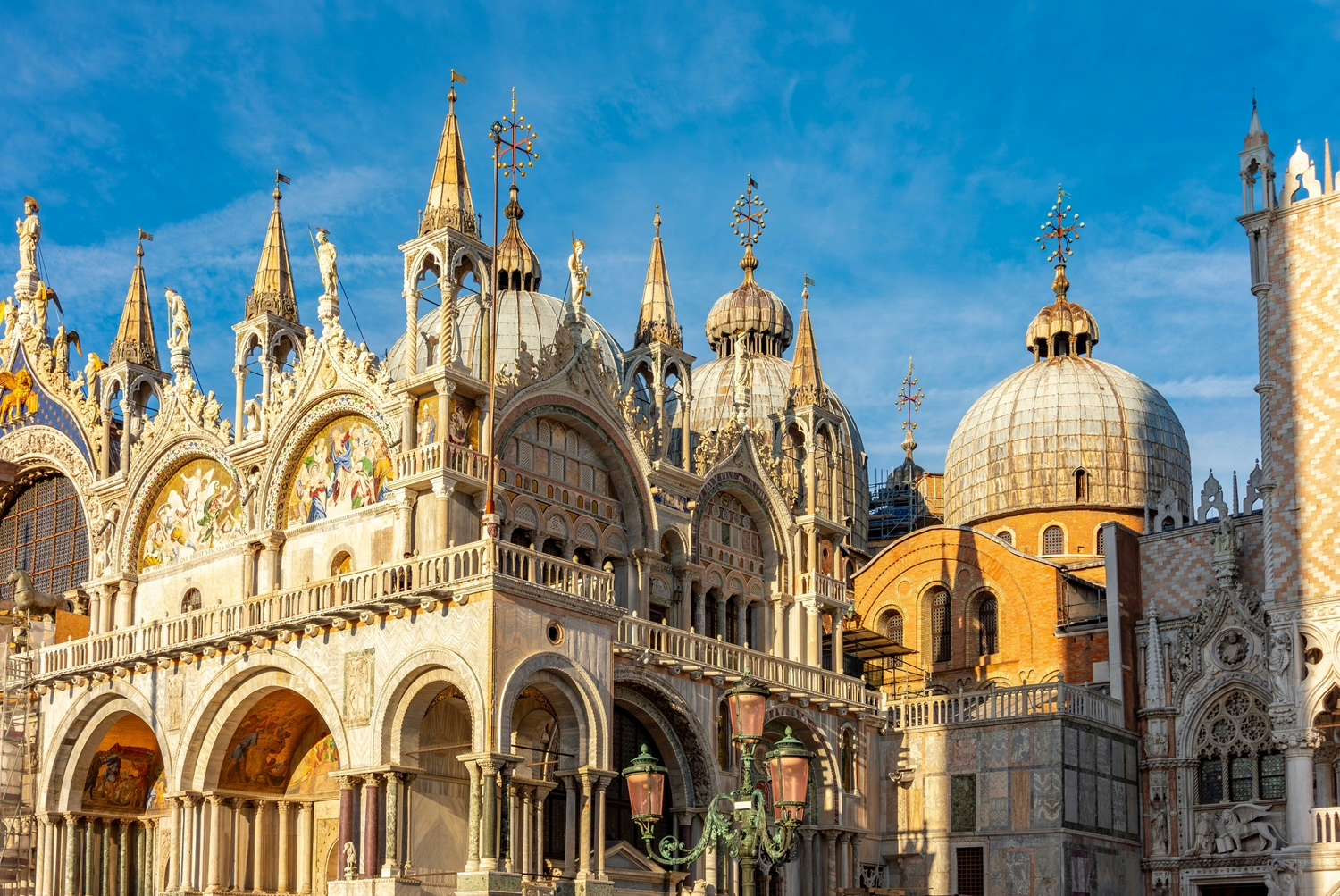
Saint Mark's basilica (Basilica di San Marco) in Venice, Italy. Photo: Mistervlad
Arts & Cultural Exchange (ACE) invites you to join a rare cultural journey through Venice and Florence, connecting contemporary art with the great traditions of European painting and sculpture within these extraordinary cities.
Led by art expert Kon Gouriotis OAM and John Kirkman (former Executive Director of ACE), the journey combines privileged access to major collections and the pleasure of attentive viewing, conversation and discovery.
Timed to coincide with the 61st International Art Exhibition of La Biennale di Venezia, ACE Italy offers a unique opportunity to experience the Biennale through the perspective of Western Sydney artist Khaled Sabsabi, who will represent Australia while also participating in the Biennale’s international exhibition – a remarkable moment in Australian contemporary art.
Participation in ACE Italy directly supports Arts & Cultural Exchange’s programs for emerging creatives from under-represented communities, across Western Sydney.
Pricing Update for 2026: Our ACE Italy program pricing has been revised for the upcoming intake. Please refer to the Cost and Booking section below for current fees and payment details.
The tour is limited to 10 participants, ensuring an intimate and thoughtful experience
throughout the journey.
Indoor view of apartament St. Mark's Cathedral (Basilica di San Marco) with beautiful decoration of the internal chambers. Italy. Photo: V_E
St Mark’s Basilica, Venice, Italy. Photo: Simona Sirio.
Arrival in Venice and hotel check-in.
A slow orientation walk introduces the unique atmosphere of Venice — its charming waterways, historic architecture, and the layered cultural history that has shaped the city for centuries.
Located in Peggy Guggenheim’s former Grand Canal residence, the Peggy Guggenheim Collection offers an intimate encounter with twentieth-century modernism.
Highlights include works by Picasso, Kandinsky, Dalí, Magritte, Pollock and Klee, alongside sculptures by Calder and Giacometti in the garden overlooking the canal.
The visit will be accompanied by a specialist museum guide.
Welcome dinner at a local restaurant.
A particular highlight of ACE Italy is a private visit to the Giardini of the Venice Biennale, led by Khaled Sabsabi, Australia’s representative at the 2026 Biennale.
Khaled Sabsabi, has the rare distinction of being the first Australian artist – and one of only a few internationally – to present works in both the Australian Pavilion as well as the main Venice Biennale international exhibition.
He has also generously offered to give our group a private tour of his work in both locations.
Joined by curator Michael Dagostino, John Kirkman and Kon Gouriotis OAM, participants will experience Sabsabi’s work in the Australia Pavilion (conference of one’s self), while gaining rare insight into the artistic ideas shaping this landmark exhibition.
This is an exceptional opportunity to explore the Biennale through the perspective of Khaled
Sabsabi, with whom ACE has a deep connection.
Individual arrangements.
Further time to explore the Giardini.
Optional: gather for pre-dinner drinks and conversation, and time to reflect on the themes
emerging across the Biennale and Khaled Sabsabi’s remarkable contribution to the exhibition.
Group dinner.
Khaled Sabsabi, 2024. Photo: Anna Kučera
VENICE, ITALY - Arsenale di Venezia towers. Photo: Pieter van Eekeren.
We will spend the day at the Arsenale, the Biennale’s vast historic shipyards where monumental contemporary works unfold across vast historic shipyard spaces.
Large-scale installations, moving-image works and ambitious curatorial projects create one of the most immersive experiences of the Biennale.
Khaled has generously offered to give our group a private tour of his work in the Arsenale.
Individual arrangements.
Special event inclusion: In the afternoon, ACE guests are invited to attend the launch of the Pavillion’s accompanying publication, featuring new scholarship on Khaled’s practice and projects for Venice.
Further exploration of the Arsenale.
Group dinner.
Situated in the Gothic Palazzo Pesaro degli Orfei, the Museo Fortuny offers a remarkable encounter with the interdisciplinary world of artist, designer and inventor Mariano Fortuny.
The museum reveals Fortuny’s visionary synthesis of painting, textile design, lighting and theatre through atmospheric interiors and historic displays.
Our visit will include a private viewing of a major monographic exhibition by Austrian sculptor Erwin Wurm.
Individual arrangements.
The Gallerie dell’Accademia houses the most important collection of Venetian painting in the world.
Guided by John Kirkman, we will encounter masterpieces by Bellini, Titian, Tintoretto and Veronese, tracing the development of Venice’s distinctive painterly tradition and its profound influence on European art.
Group dinner.
VENICE, ITALY - Palazzo Pesaro degli Orfei Facade on Campo san Beneto. Photo: Didier Descouens.
VENICE, ITALY - Palazzo Grassi. Photo: Didier Descouens.
The Chiesa di Santa Maria-Assunta, a leisurely vaporetto ride from San Marco, stand as a triumphant synthesis of high-Baroque theatricality and immaculate stonemasonry. Consecrated in 1728 to designs by Domenico Rossi, the interior is defined by an unprecedented virtuosity of green-and-white marble inlay that dissolves the rigid boundaries of architecture into the soft, undulating illusion of draped textile.
Group lunch.
Following lunch, we will walk across the Rialto Bridge, one of Venice’s most iconic vantage points across the Grand Canal, pausing briefly to take in the memorable light and views before continuing to Fondazione Prada.
Housed in the eighteenth-century Ca’ Corner della Regina, Fondazione Prada presents ambitious exhibitions that bring contemporary artistic practice into dialogue with historic architecture.
Its program is known for intellectually rigorous curatorial projects and bold international perspectives.
The program may include the special exhibition “Helter Skelter: Arthur Jafa and Richard Prince”, curated by Nancy Spector, bringing together the works of two of the most influential American artists, in a striking and previously unexplored dialogue.
Free to explore Venice and enjoy dinner independently.
Depart Venice for a full day in Umbria.
Our group will be welcomed by collectors and philanthropists Simon Mordant AO and Catriona Mordant AM, who will open their residence in Umbria for a private luncheon. Guests will enjoy a rare opportunity to view the Mordants’ exceptional contemporary art collection while engaging in conversation about art patronage and collecting.
Arrive in Florence late afternoon/early evening.
Free evening.
Florence, capital of Tuscany and cradle of the Renaissance, offers an extraordinary concentration of artistic and architectural masterpieces shaped by the Medici and generations of artists.
The Museo di San Marco is housed in a 15th-century Dominican convent. Rebuilt by Michelozzo for Cosimo de’ Medici the Elder, the Renaissance complex is celebrated for holding the world’s premier collection of works by Fra Angelico.
The significance and power of Fra Angelico’s forty-four San Marco frescoes lie in their revolutionary blend of avant-garde Renaissance technique, deep spiritual functionality and modest simplicity.
Group lunch.
The Galleria dell’Accademia di Firenze houses Michelangelo’s monumental David, together with the unfinished Prisoners, originally intended for the tomb of Pope Julius II.
Beyond Michelangelo, the gallery holds an important collection of Florentine painting from the thirteenth to the sixteenth centuries.
Free evening.
FLORENCE, ITALY - David by Michelangelo, Galleria dell'Accademia, Florence, 1501-1504. Photo: Jörg Bittner Unna .
Raffaello Sanzio (1506). Mary, Christ and the young John the Baptist, known as “Madonna of the Goldfinch” (Oil on wood). Uffizi Gallery, Florence.
The Chiesa di Santa Felicita is located near the Ponte Vecchio. It is considered the second-oldest church in Florence and is world-renowned for housing Jacopo Pontormo’s, The Capponi Altarpiece, works by Bronzino as well as its direct structural connection to the famous Vasari Corridor.
Group lunch.
Founded in 1294, the Basilica of Santa Croce stands as a cultural pillar of Florence, serving as a monument to spirituality, intellectual history, and Renaissance art. In particular, it is an expansive museum of late medieval and early Renaissance genius.
The interior walls feature revolutionary 14th-century fresco cycles by Giotto in the Bardi and Peruzzi Chapels.; and boasts the Pazzi Chapel, a masterpiece of geometric harmony designed by Filippo Brunelleschi, alongside exceptional sculptural works by Donatello.
Known as the “Temple of the Italian Glories,” the Santa Croce sacred houses the tombs of Michelangelo, Galileo Galilei, and Niccolò Machiavelli and a grand cenotaph honouring the poet, Dante.
Free evening.
The Bargello, in the Palazzo del Podestà is a fortified medieval palace constructed in 1255 as the oldest public building in Florence. Originally serving as the seat of the city’s magistrate, it later functioned as a prison and police headquarters before opening its doors in 1865 as Italy’s first national museum dedicated to the arts.
The museum houses the world’s most extensive collection of 14th to 17th-century Italian Renaissance sculpture. Its masterpiece holdings include Donatello’s bronze David, Michelangelo’s early Bacchus, and significant sculptures by Verrocchio, Cellini, and Giambologna.
Casual.
The Uffizi Gallery is one of the oldest, most prestigious museums in the world. Originally commissioned in 1560 by Cosimo I de’ Medici the building was designed by Giorgio Vasari and eventually transformed into a private exhibition space. Its significance is anchored in this foundational history, as the institution pioneered the concept of the public art museum when the Medici collection was bequeathed to the city of Florence in the 18th century.
The Uffizi serves as the definitive repository for Italian Renaissance art; its collection features epoch-defining masterpieces, including Botticelli’s The Birth of Venus, da Vinci’s Annunciation, Michelangelo’s Doni Tondo, Raphael’s Madonna of the Goldfinch, and Caravaggio’s Medusa.
Farewell group dinner.
Sandro Botticelli (1480). Primavera (Tempera on panel). Uffizi Gallery, Florence.
FLORENCE, ITALY - Giambologna. Bathing Venus statue. Buontalenti Grotto, Boboli Gardens. Photo: Yanko Malinov.
Our final morning in Florence brings us to the Palazzo Pitti and the Boboli Gardens, where art, architecture and landscape converge in one of the most complete expressions of Renaissance court culture.
Once the residence of the Medici dynasty, Palazzo Pitti houses several museums including the Galleria Palatina, renowned for its High Renaissance and Baroque paintings by Raphael, Titian and Rubens.
Behind the palace lie the magnificent Boboli Gardens, one of the earliest and most influential examples of the Italian Renaissance garden.
Formal program concludes.
The Birth of Venus, Painting by Sandro Botticelli in the Uffizi Gallery, Florence. Photograph: Christian Mueller.
*To ensure availability, we have reserved hotel rooms for guests. Please see the accommodation options below.
St Mark's Basilica, Venice, Italy. Photograph: Irentravel
ACE Italy has been carefully planned so participants can focus on the art and experience of the cities, while practical arrangements are organised to make the journey relaxed and enjoyable.
Participants are welcome to make their own accommodation arrangements. However, if you would prefer assistance, our travel agent Suzie Sabbarese has reserved rooms for ACE Italy guests at several hotels in Venice and Florence.
Suzie Sabbarese
Flight Centre
Email: [email protected]
Mobile: +61 2 4654 7555
Suzie is Italian-speaking and has over 20 years’ experience organising international travel, including many trips to Italy — a destination she describes as her favourite.
To ensure a relaxed and seamless experience, a member of the ACE team will meet guests at each hotel every morning so the group can move between venues together without the stress of navigating the city. Participants will also receive a map with the galleries and sites clearly
marked, and we will establish a WhatsApp group so guests can stay easily connected throughout the journey.
All hotel rates include breakfast.
Sina Centurion Palace (5★): $5,394 per week (approx. $1,000 per night)
Hotel Concordia (4★): $605 per night
Hotel Cavaletto & Doge Orseolo: $540 per night
Hotel Machiavelli: $507 per night
Croce di Malta: $638 per night
Dimora Palanca Boutique & Spa: $660 per night
If you would like to take advantage of our accommodation options, please feel free to contact
Mandy O’Bryan. T. 0414 857 812. E. [email protected]
If you would like assistance in booking flights, please get in touch with our travel agent.
Twilight at Duomo Florence in Florence, Italy. Photograph: Nattee Chalermtiragool
Golden portal of the Baptistery, Florence, Italy. Photograph: Yuri Turkov.
Venice, Italy - August 9, 2025: view of the museum inside St. Mark's Cathedral. Photograph: WINDCOLORS